
Article: Aya: Japanese Mosaic from Kasahara, Made to Be Combined

Aya: Japanese Mosaic from Kasahara, Made to Be Combined
Some tiles are best understood as a finished surface. Aya is better understood as a kit of parts. It is an unglazed Japanese porcelain mosaic in four simple shapes and six natural clay colours, and its character comes from how those pieces are mounted, mixed and combined. It is made by Yamashu Ceramic, one of the smallest makers we work with, in Kasahara, Japan's mosaic tile town.
Kasahara, the town of mosaic
Kasahara, now part of Tajimi City in Gifu Prefecture, lies in the Mino region, which has made ceramics for centuries. Through the Edo period it was known for rice bowls, called Kasahara chawan. That changed in the 1920s. After the Great Kantō Earthquake of 1923, fire-resistant, Western-style buildings clad in tile were in demand, and many of the town's potters moved from bowls to tiles (Ozawa Mosaic Tile).
The turning point for mosaic came from a local maker, Yamauchi Itsuzo. Born in Kasahara, he studied ceramics and glazes in Kyoto, returned home in 1929 to open a tile factory, and in 1935 completed his own method for producing porcelain mosaic in quantity. Unusually for the time, when makers guarded their techniques closely, he shared what he had learned with other producers in the town. The result was a change in how tiles were made across Kasahara, which became a centre of post-war tile production (Japan Tourism Agency). Today Kasahara is Japan's largest producer of mosaic tile, and it is home to the Mosaic Tile Museum, Tajimi.
Yamashu Ceramic
Yamashu Ceramic has made tiles in Kasahara since 1984 (Yamashu Ceramic). It is best known in Japan for 10 mm square mosaic, a format few makers in Japan still produce, and it keeps to traditional methods that involve a great deal of handwork. The company also runs a tile art studio, which turns photographs into mosaic murals from more than 80 tile colours, placing each tile by hand (Yamashu Ceramic).
The link to the town's history is close to home. The only surviving installation of the art tiles Yamauchi Itsuzo made after the war is on the exterior wall of the Yamashu family home, dating from around 1976. The Mosaic Tile Museum includes it on walking tours of Kasahara, together with a visit to the Yamashu factory led by the company's president, Yuo Nagae (Mosaic Tile Museum, Tajimi).
How Aya works
Aya starts with four shapes:
- Border: a slim 47.5 × 10 mm stick.
- Chevron: a 44 × 20 mm angled piece.
- Clover: a small four-lobed flower.
- Hex: a small hexagon.
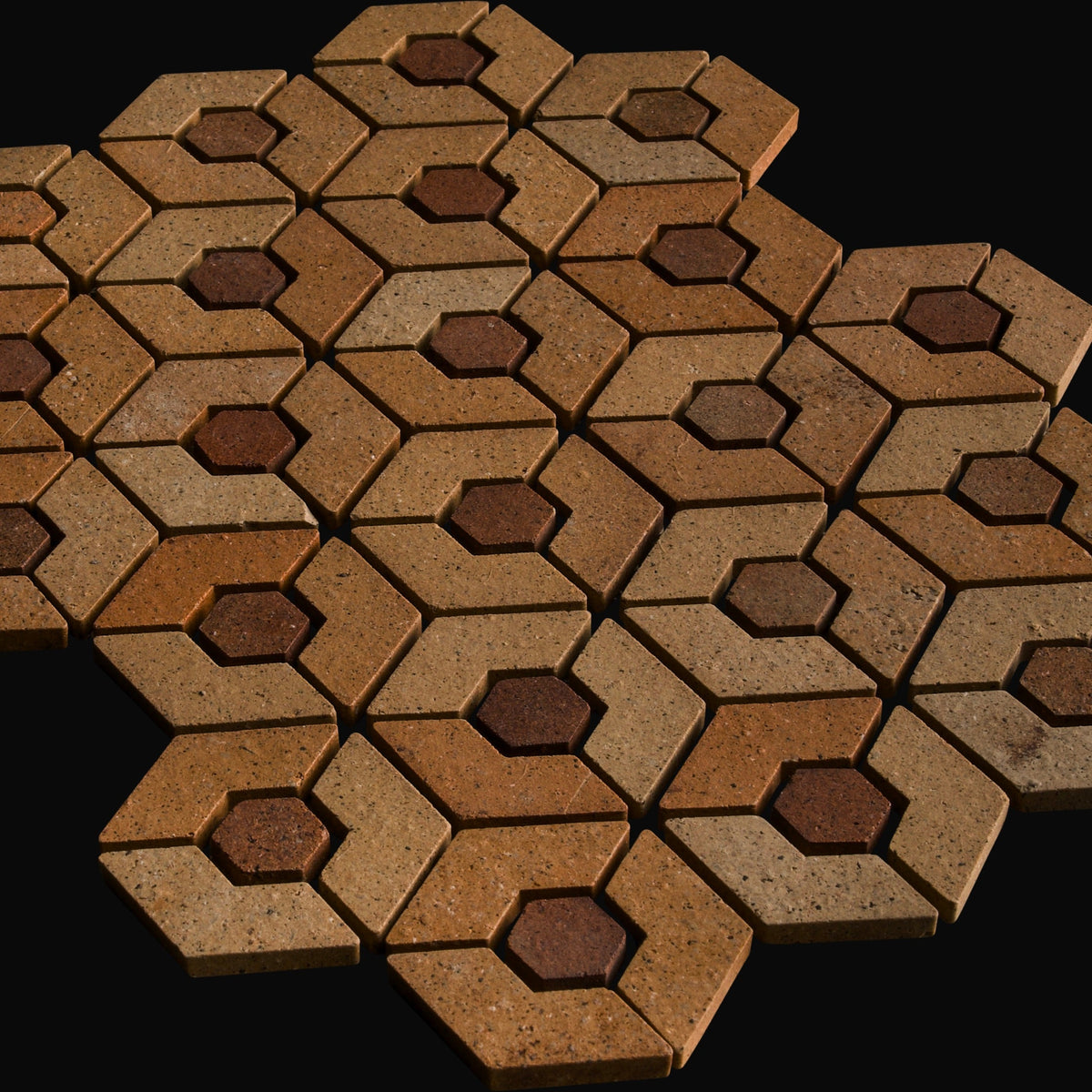
Each shape can then be mounted in different ways, and each mount gives the wall a different rhythm. Border sticks can run in straight lines, weave into a basket-weave check, or zig-zag as herringbone. Chevrons can run in rows, alternate direction, or lock together in a three-way Y pattern that reads almost like tumbling blocks. Clover and Hex are mounted in even grids that read as a soft, textured field.
Shapes can also be combined. Tortoiseshell Mount sets chevrons around a hexagonal centre in two colours of your choice, turning a simple piece into a larger repeating motif.
Placed by hand, one tile at a time
What a photograph cannot show is how the sheets are made. Every one of these tiny tiles is placed on its mesh by hand, one at a time, as Japanese tiles are. This is one of the most important parts of quality control. Each firing produces natural variation in colour, and as the tiles are placed that variation is balanced across the whole sheet, so that no patch ends up too light or too dark. Balanced sheets make a balanced wall. It is slow, careful work, and it is a large part of why a wall of Aya looks natural rather than patchy.
Six colours, and your imagination
The six colours are Sand, Ochre, Umber, Chalk, Limestone and Ash, ranging from soft off-white and pale stone to golden ochre, deep reddish brown and quiet grey. Because the tiles are unglazed, the colour runs through the porcelain body, and fine speckling gives each piece the look of natural stone and clay.
With nine formats and six colours, and two-colour mixes on top of that, there are far more possibilities than we could ever photograph. Our images show every shape and every mount, and every colour appears across the set, but not every combination is pictured. They are a starting point. Picture the herringbone in Chalk for a calm, textile-like wall, the Hex in Ash for something cooler and more architectural, or a Tortoiseshell of Limestone and Sand for a pattern that only shows itself up close.
Made in small quantities
Yamashu Ceramic is a very small maker, and Aya is produced in small quantities. It is not a tile for large areas. It is suited to select projects: a feature wall, a reception desk, a niche, a bar front, or a small room where the detail can be seen and enjoyed. Aya is for indoor walls and is frost-proof; it is not intended for wet walls, outdoor walls or floors.
Because stock is limited, please contact us to confirm availability and discuss your colour and pattern choices before specifying. Samples are not currently available.
Craftsmanship. Heritage. Timeless elegance.