
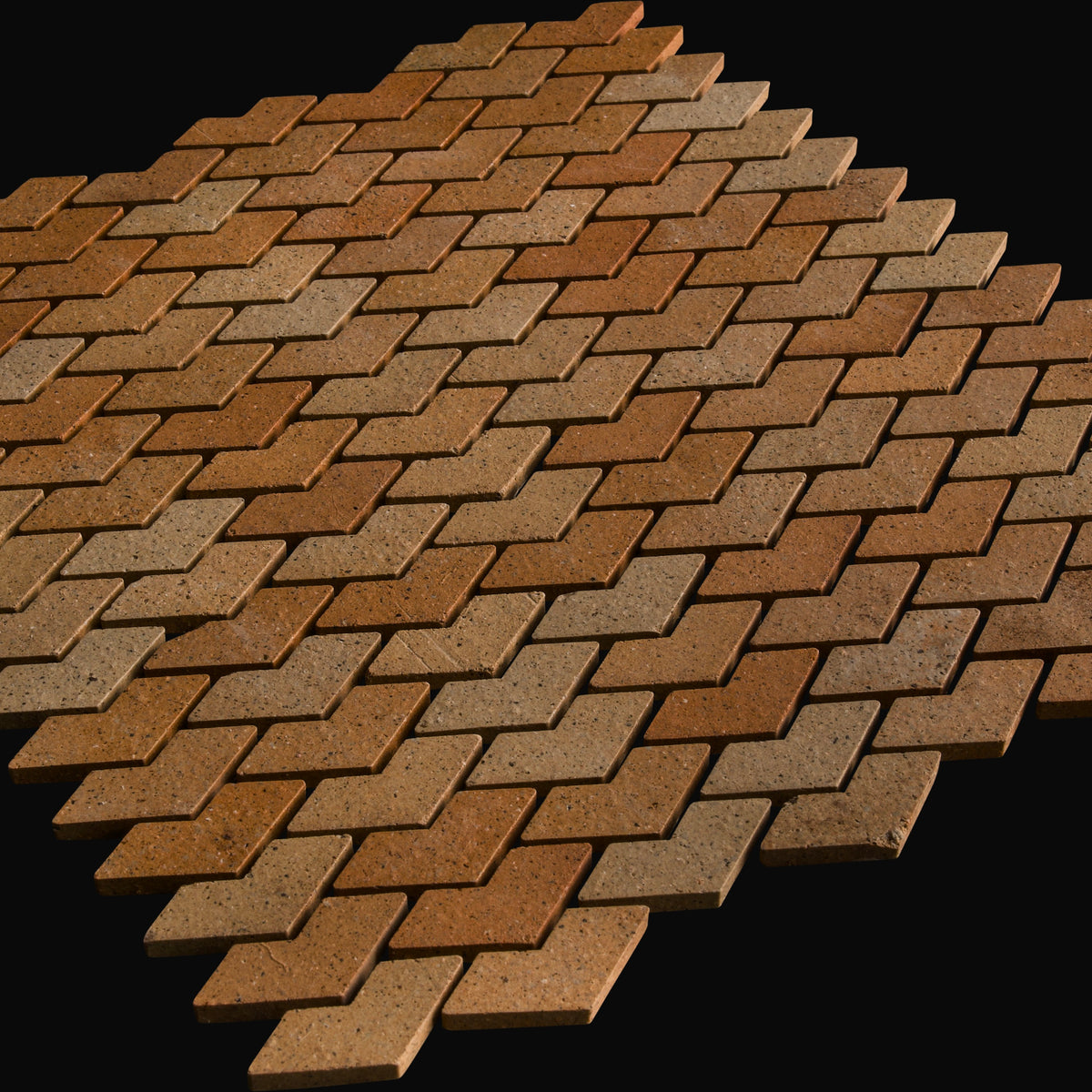
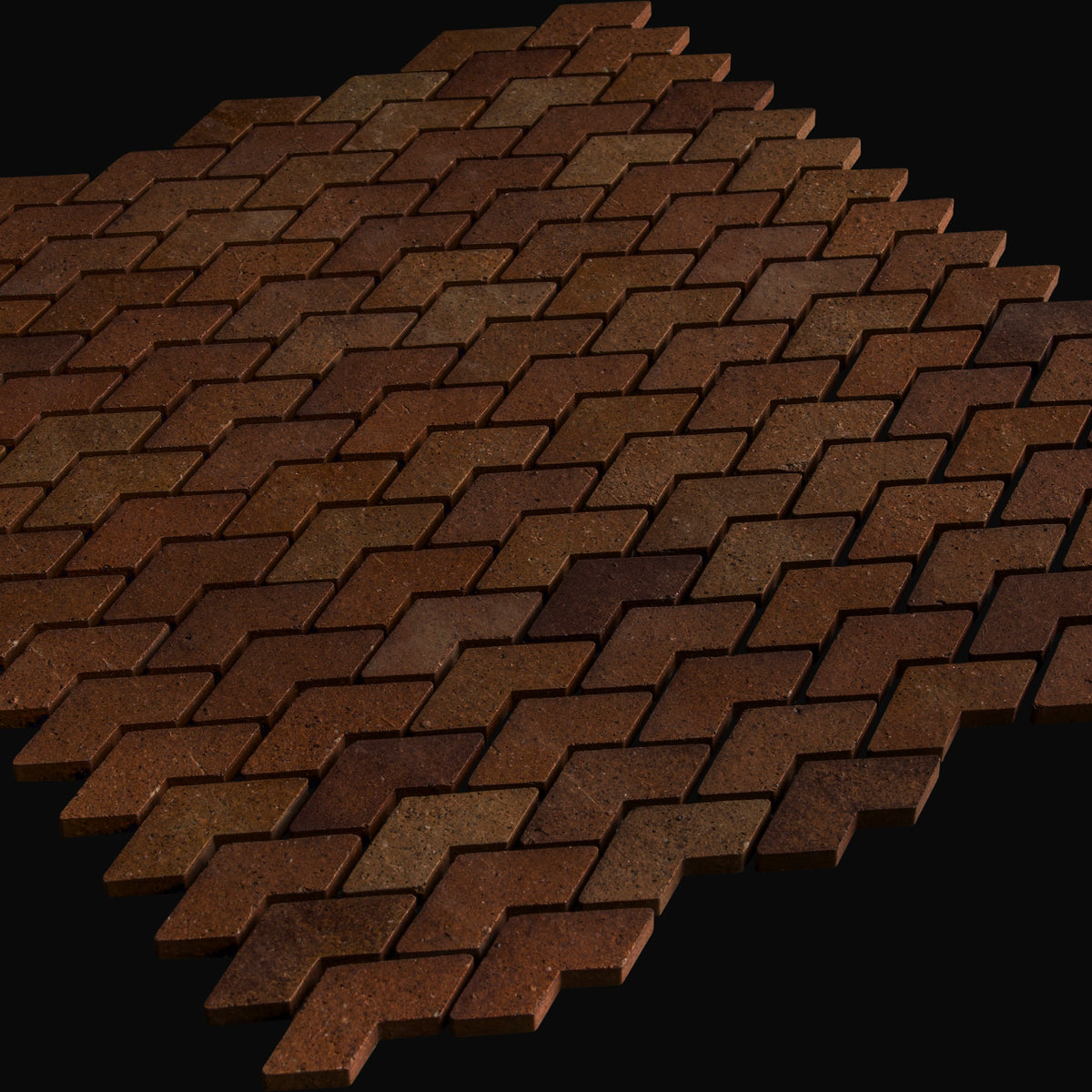
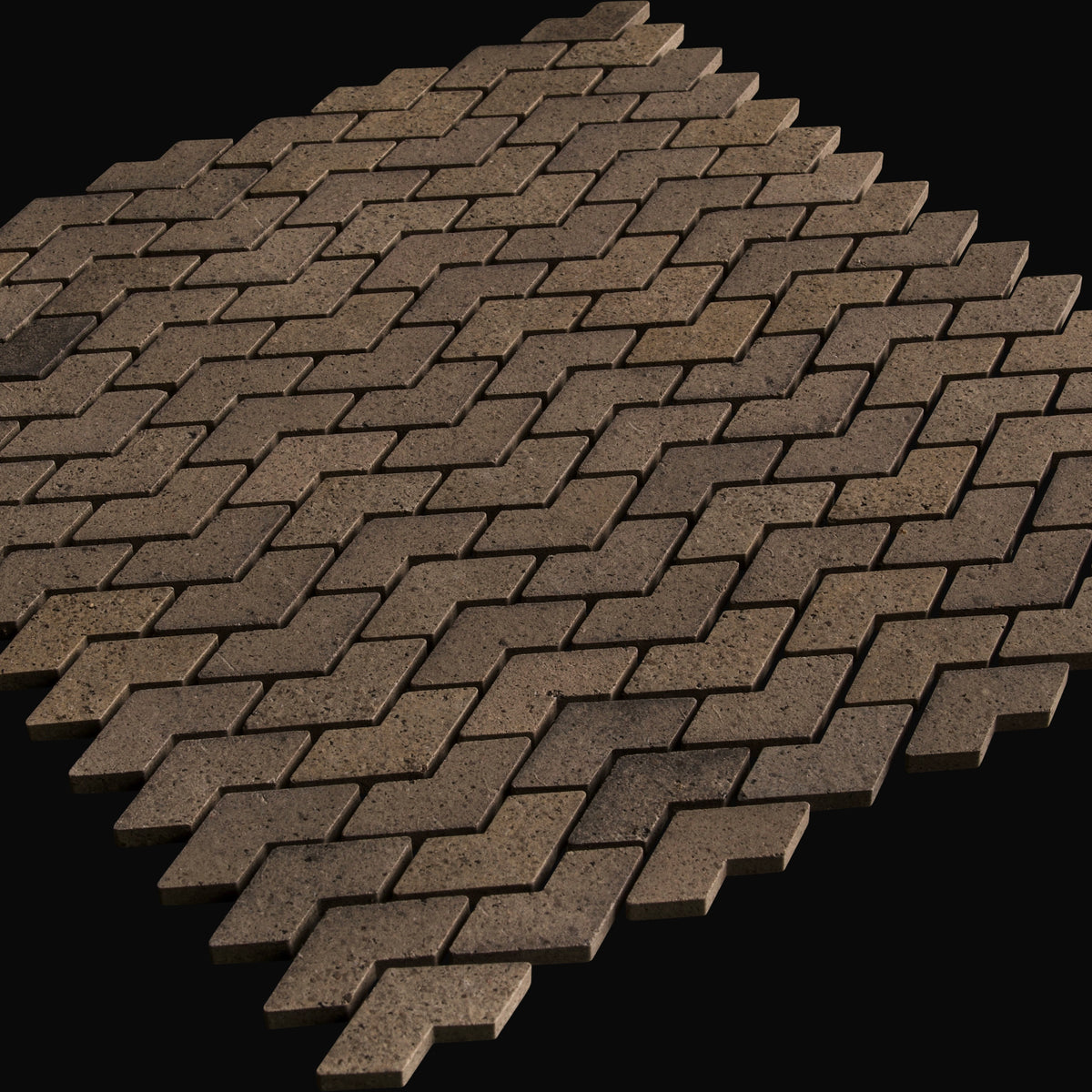
Aya is an unglazed Japanese porcelain mosaic made by Yamashu Ceramic, a small tile maker in Kasahara, Tajimi, the town at the heart of Japan's mosaic tile industry. In Japanese, aya describes a woven or figured pattern, and that is how the range works: four simple shapes and six natural clay colours that can be mounted, mixed and combined into a pattern of your own.
Four shapes
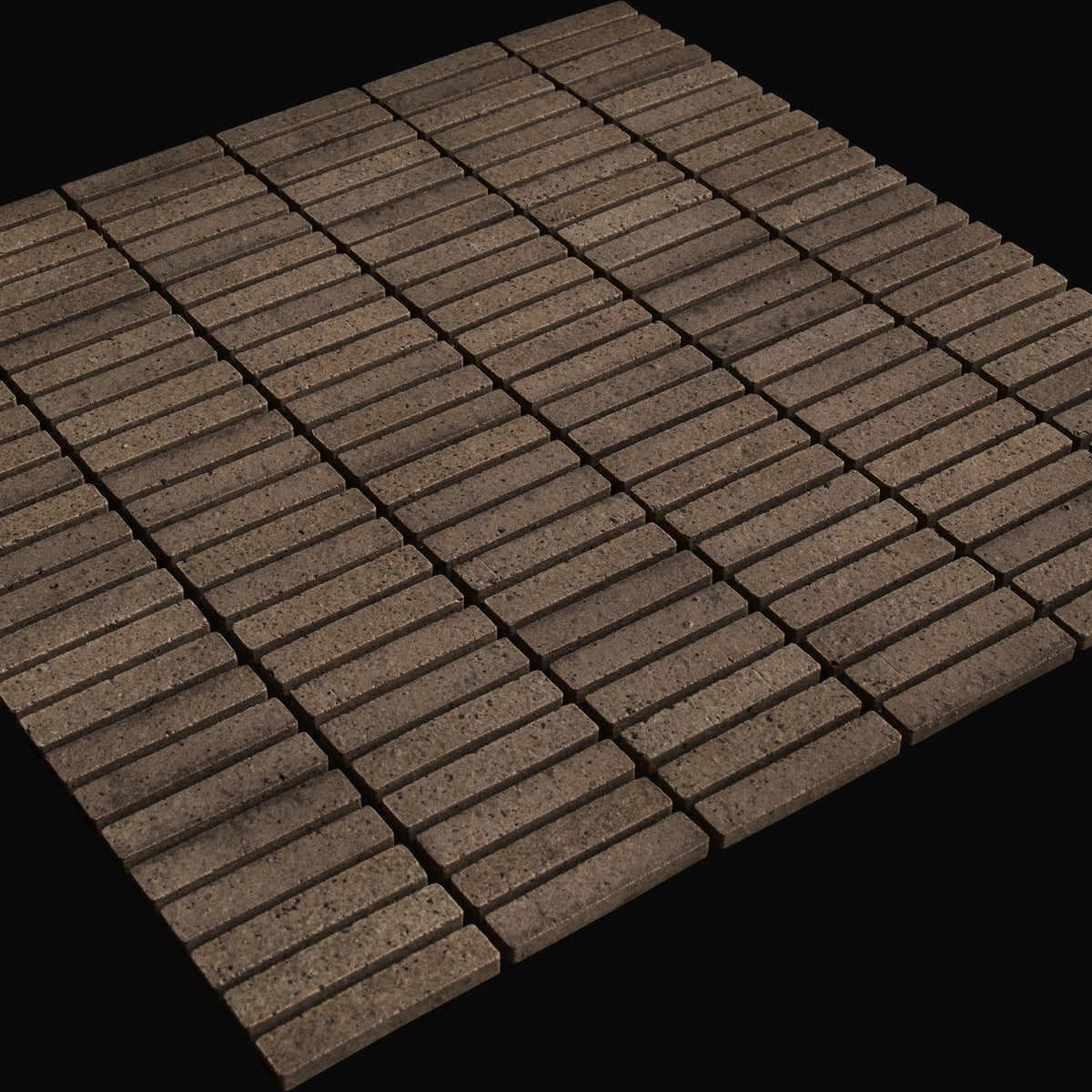
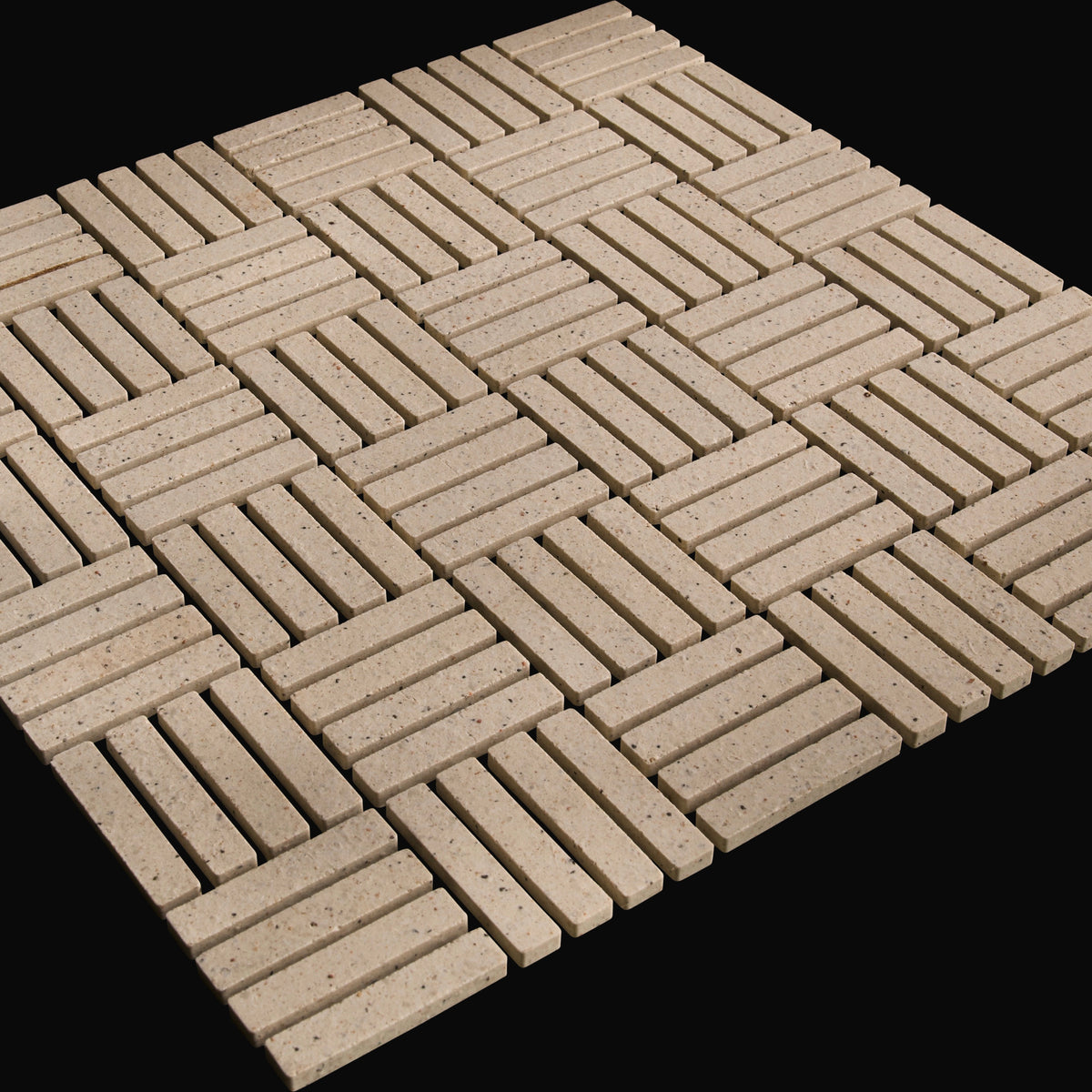
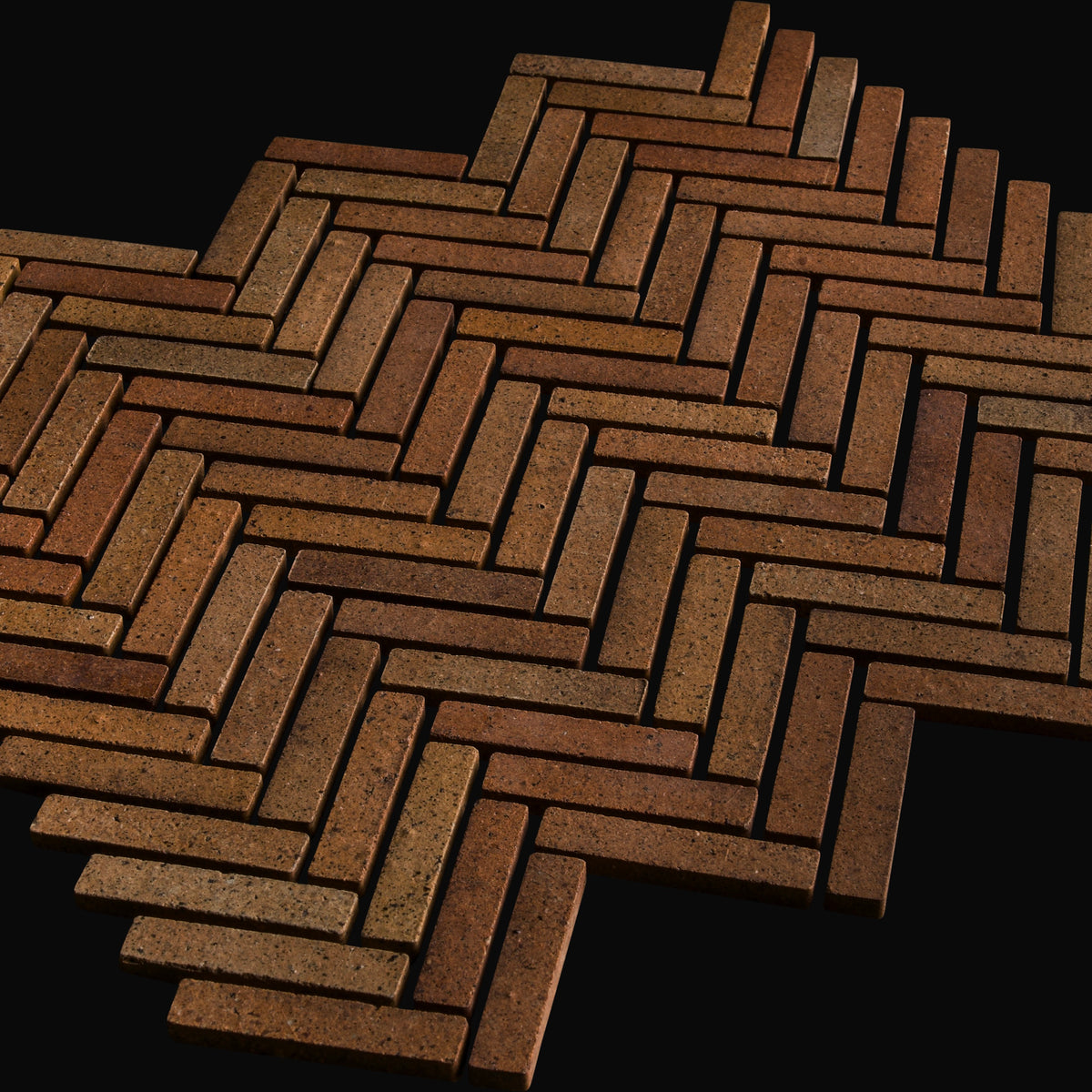
- Border: a slim 47.5 × 10 mm stick, available as Straight Mount, Basket Weave or Herringbone.
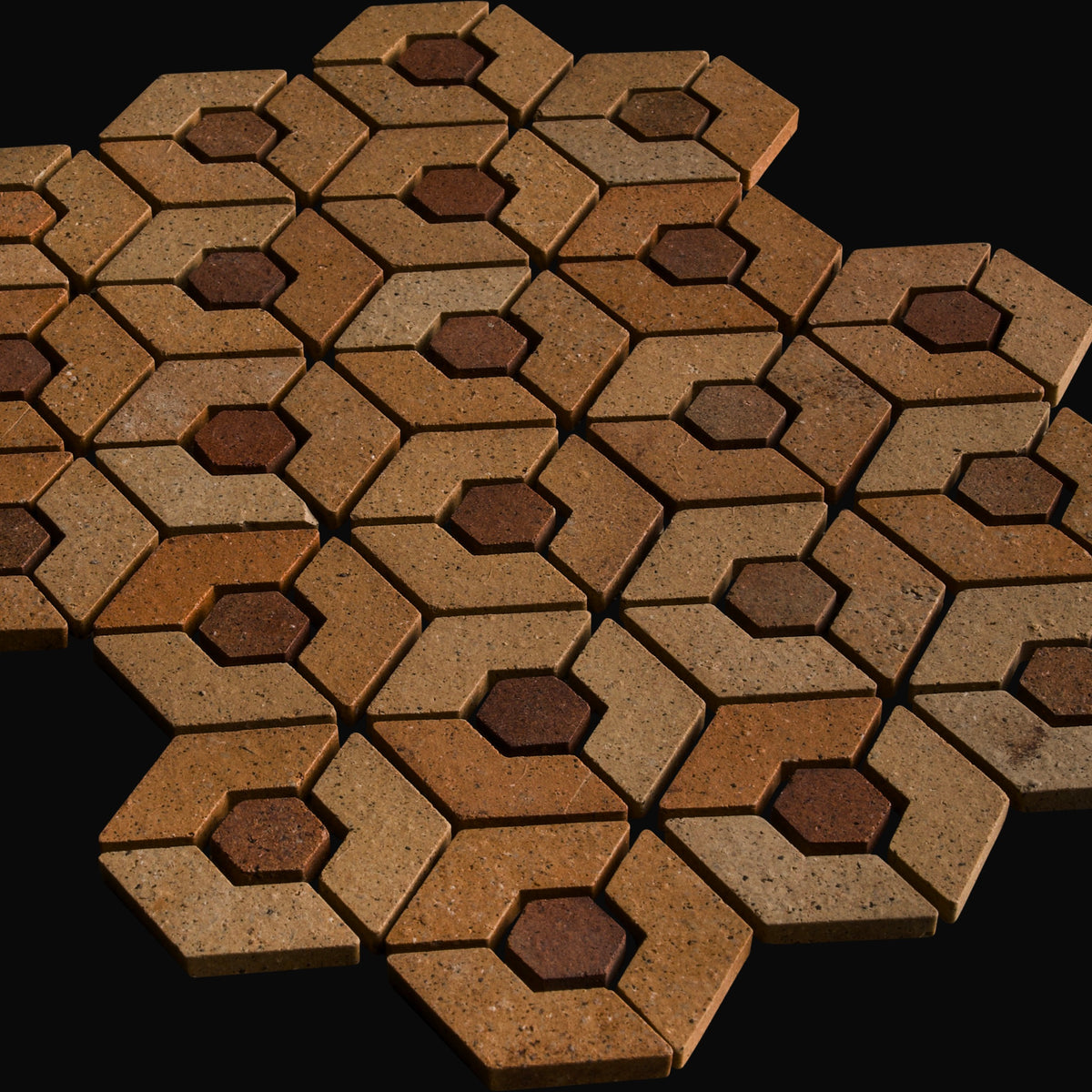
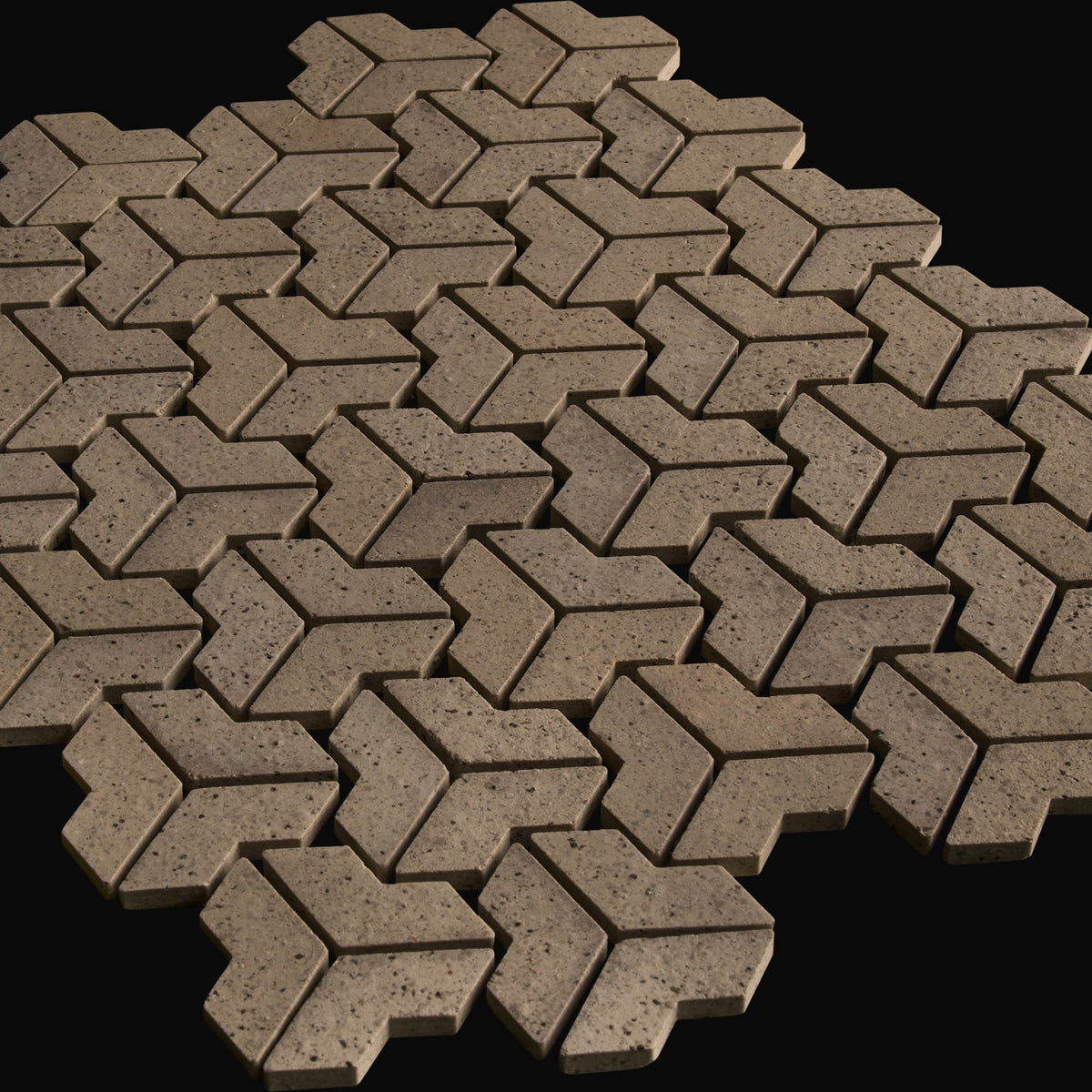
- Chevron: a 44 × 20 mm angled piece, available as Straight Mount, Alternative Mount or Y Mount.
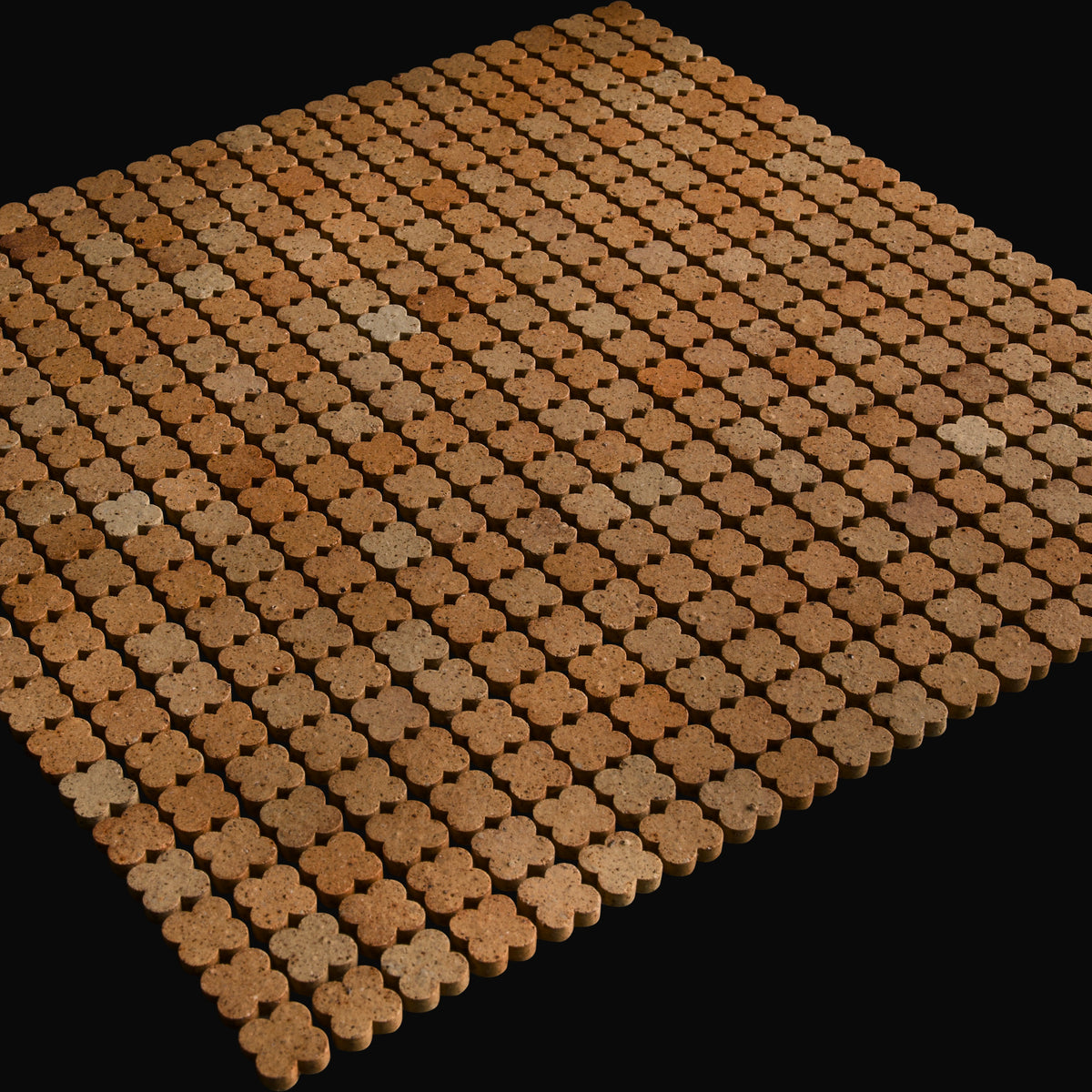
- Clover: a small four-lobed flower shape, mounted in an even grid.
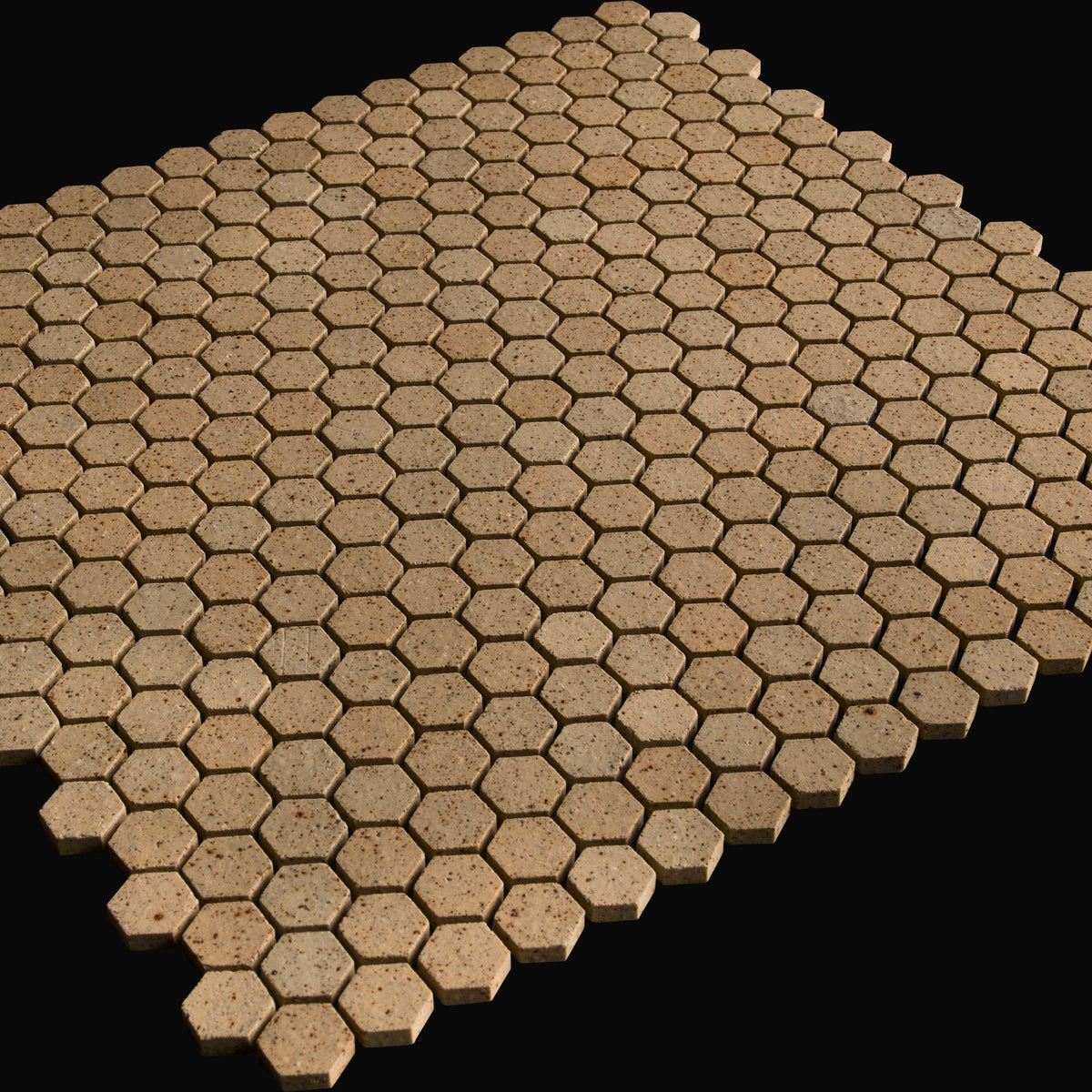
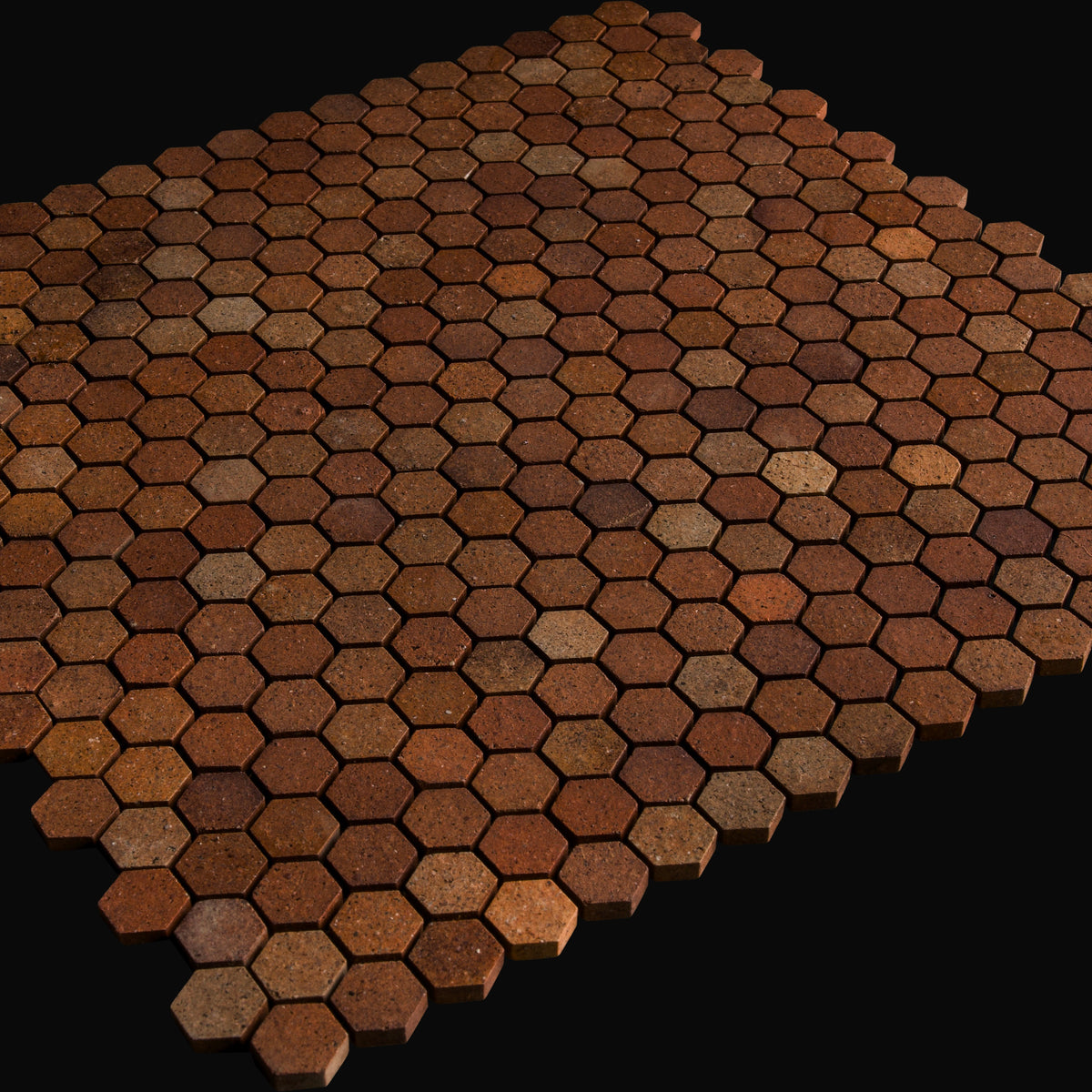
- Hex: a small hexagon, mounted in a honeycomb.
Mounts and mixes
The same piece reads very differently depending on how it is mounted. Border sticks laid straight give quiet, linear rhythm; in Basket Weave they form a woven check; in Herringbone they zig-zag across the wall. Chevrons can run in rows, alternate direction, or lock together in a three-way Y pattern that reads almost like a tumbling block.
Shapes can also be combined. Tortoiseshell Mount sets chevrons around a hexagonal centre, and is made in the two colours you choose. The image shows Ochre chevrons around an Umber centre, but any pairing of the six colours is possible. Please tell us your colour choice when you order.
Mounted by hand
Every one of these tiny tiles is placed on its sheet by hand, one at a time, as Japanese tiles are. It is a key part of quality control: as each tile goes down, the natural colour variation from the kiln is balanced across the sheet, so no patch is too light or too dark. Balanced sheets make a balanced wall.
Using the images
Our photographs show every shape and mount, and every colour appears across the set, but not every combination is pictured. With nine formats and six colours there are too many to photograph them all. Use the images as a guide and let your imagination do the rest: picture the Herringbone in Chalk, the Hex in Ash, or a Tortoiseshell of Limestone and Sand.
Six colours
Sand is a warm, sandy beige; Ochre a golden, earthy orange; Umber a deep reddish brown; Chalk a soft off-white; Limestone a pale, flecked stone; and Ash a quiet mid grey. Because the tiles are unglazed, the colour runs through the porcelain body. Fine speckling and moderate tonal variation from tile to tile give the surface the look of natural stone and clay.
The maker
Yamashu Ceramic was founded in 1984 in Kasahara-cho, Tajimi, in Gifu Prefecture, and is known in Japan for 10 mm square mosaic, a format few makers in Japan still produce. Its tiles are made using traditional methods, with a great deal of handwork. Kasahara has been Japan's mosaic tile town since the 1930s, when local maker Yamauchi Itsuzo developed a way to produce porcelain mosaic in quantity and shared his methods freely with other local makers.
For select projects
Yamashu Ceramic is a very small maker and Aya is produced in small quantities. It is best suited to select projects, feature walls and smaller areas rather than large installations. Please contact us to confirm availability before specifying. Samples are not currently available.
Specification
Aya is suitable for indoor walls and is frost-proof. It is not intended for wet walls, outdoor walls or floors. Tiles are 5 mm thick, supplied on mesh-backed sheets with 3 mm joints, 26 sheets per carton. Sheet size and coverage vary by format; see the details for each format.
All of our tiles originate in Japan, but we hold selected stock in our local markets to make supply faster and simpler.
This allows us to offer both immediate availability from local stock and a much wider range from Japan.
Because every project is different, delivery times can vary depending on where the tiles are held, when they are available and how they are being shipped.
Where are your tiles shipped from?
Our tiles are made in Japan.
For our main markets, we also hold selected local stock in Dubai, Germany and the United Kingdom.
Products held in Dubai, Germany or the UK are usually dispatched within 1 to 2 working days.
Delivery is typically completed within 1 to 10 days, depending on the distance from the warehouse to you.
Do you keep every tile in stock?
No.
Japanese tile collections are extensive and many products are made in relatively small quantities.
For this reason, we stock selected ranges locally and source the remainder directly from Japan when required.
Each product page will indicate whether the item is available from local stock or supplied from Japan.
Why don't you keep all products in stock locally?
Because the range is too large.
Our own database already includes more than 1,000 tile variations, and there are many thousands more available from our factories' current and back catalogues.
Holding every product in every market would significantly increase cost and reduce the range we can offer.
Our supply model allows clients to access a much wider selection of authentic Japanese tiles, while still keeping selected popular products available for faster local delivery.
How long does delivery from Japan take?
For tiles supplied from Japan, the shipping timeline starts once the tiles are available for dispatch.
- Dubai: typically 6 to 8 weeks from availability
- UK and Europe: typically 12 to 14 weeks from availability
This can vary depending on production schedules, shipping conditions, customs processing and local handling.
How are Japan orders shipped?
Large orders can usually travel on their own dedicated shipment. This is normally the fastest sea freight option.
Smaller orders can often travel with one of our scheduled stock shipments. This is usually much more cost-effective, but the order may need to wait for the next available dispatch.
Where both options are available, they will be shown at checkout so you can choose the balance of cost and timing that suits your project.
Why do you ship on pallets?
Tiles are heavy, fragile products.
Although individual cartons can technically be shipped, the risk of damage increases significantly.
For this reason, project orders are normally shipped on pallets to ensure they arrive safely and in good condition.
Pallet delivery is the safest and most reliable way to transport specialist ceramic materials.
Can I order samples?
Yes.
Samples can be ordered directly through our website.
Samples are sent by courier from our warehouse.
Typical sample delivery is between 2 and 10 days.
For architects, interior designers and other trade professionals, complimentary samples may be available through our Specifier Program.
Do you ship internationally?
Yes.
Our primary markets are the UAE, UK and Europe, where we hold stock and operate established supply chains.
We can also support projects in many other countries where the order size and shipping route are practical.
For projects outside our core markets, please contact us to discuss availability and shipping options.
Will I have to pay customs duties or import taxes?
In our core markets of the UAE, UK and EU, our transaction with you is on a domestic basis.
This means you do not need to arrange import clearance or pay import duties separately to receive your order.
For projects outside these markets, import duties, taxes and customs clearance requirements vary by country and are usually the responsibility of the importer.
Where this applies, we will explain the process before confirming the order.
Can I return tiles?
Local stock items may be returned, provided they are unopened, undamaged and returned within the required time period.
Products supplied from Japan and all samples are non-returnable.
Because specialist tiles are often ordered specifically for a project, we strongly recommend reviewing samples and quantities carefully before ordering.
Many projects involve a mixture of local stock, Japanese stock, special orders and samples.
If you are unsure about lead times, availability or shipping options, please contact us and we will be happy to help.
Authentic Japanese ceramic tiles for architectural and interior design projects.
Mittsu specialises in tiles made in Japan, selected for their surface depth, natural glaze variation and architectural character.
Unlike mass-produced alternatives, these tiles are not defined by printed patterns. Their colour and texture are created during firing in the kiln, producing subtle variation across the surface once installed.
Choosing a tile
Japanese tiles are typically selected for their material quality rather than a fixed visual pattern.
Variation between tiles is part of the character. Across a wall, this creates depth and movement rather than repetition.
Collections can be explored online, but most projects benefit from reviewing physical samples before final selection.
Samples
Samples allow colour, glaze movement and surface texture to be evaluated under real lighting conditions.
They are ordered directly through product pages using the sample option for each tile.
For professional projects, the Specifier Program provides access to complimentary samples and technical resources.
Availability and supply
Tiles may be supplied from our stock in the UK, Europe, UAE and Japan, or produced to order depending on the collection and project requirements.
Lead times vary accordingly and should be considered during the design stage where tiles form part of the architectural concept.
Working with Mittsu
Mittsu works directly with architects, interior designers and private clients across residential, hospitality and commercial projects.
Each enquiry is handled with a focus on material selection, availability and suitability for the intended application.
Japanese tiles are specified as materials, not finishes.
Aya - Japanese Porcelain Mosaic Wall Tile
| Price per Box (and m2)
Box coverage varies by tile, from 0.2 to 2 m². For complete transparency and easy comparison, we display both the price per box and the price per m². |
|
| Availability
Stock Availability & Shipping. Stocked Locally: Ships from the UK, Germany or UAE for faster delivery. When this is sold out, we revert to > Japanese Stock: Shipped from Japan just for you. Made to Order: Produced and shipped from Japan just for you. Lead times and minimum order quantities are listed in the product description. |
Japanese Stock |
| Stock | This tile is typically held in stock in Japan; however, availability is confirmed with each order. In the event of limited stock or any delay, we will promptly offer suitable alternatives or arrange an immediate refund. |
| Tiles |
Technical data
| m2 per Box | 2.34 |
| Items per Box
This is how many sheets or individual tiles are in a box. |
26 |
| Items per m2
This is how many sheets or individual tiles are needed for 1m2 |
11.1 |
| Tile Size (mm) | 47.5x10x5 / 44x20x5 / 13.5x13.5x5 / 18x15.6x5 |
| Joint Size (mm)
This is the size of the gap between tiles on a sheet or an assumed size for loose tiles. |
3 |
| Supplied in Boxes of | Sheets on Mesh Back |
| Sheet Size (mm) | 300x300 |
| Application | Indoor Wall and Frost Proof |
| Glazed? | Japanese, Unglazed, Stone, Border, and Hexagon |
| Surface Finish | Flat and Light Texture |
| Body Quality
This is defined by the water content within the body after firing |
Porcelain |
| Colour Variation
The variation of how the tiles compare to each other in a box |
Moderate |
| Texture Variation
The variation of how the tiles compare to each other in a box |
Low |
| Colour Fading | Zero |
| Country of Manufacture | Japan |
Aya is an unglazed Japanese porcelain mosaic made by Yamashu Ceramic, a small tile maker in Kasahara, Tajimi, the town at the heart of Japan's mosaic tile industry. In Japanese, aya describes a woven or figured pattern, and that is how the range works: four simple shapes and six natural clay colours that can be mounted, mixed and combined into a pattern of your own.
Four shapes
- Border: a slim 47.5 × 10 mm stick, available as Straight Mount, Basket Weave or Herringbone.
- Chevron: a 44 × 20 mm angled piece, available as Straight Mount, Alternative Mount or Y Mount.
- Clover: a small four-lobed flower shape, mounted in an even grid.
- Hex: a small hexagon, mounted in a honeycomb.
Mounts and mixes
The same piece reads very differently depending on how it is mounted. Border sticks laid straight give quiet, linear rhythm; in Basket Weave they form a woven check; in Herringbone they zig-zag across the wall. Chevrons can run in rows, alternate direction, or lock together in a three-way Y pattern that reads almost like a tumbling block.
Shapes can also be combined. Tortoiseshell Mount sets chevrons around a hexagonal centre, and is made in the two colours you choose. The image shows Ochre chevrons around an Umber centre, but any pairing of the six colours is possible. Please tell us your colour choice when you order.
Mounted by hand
Every one of these tiny tiles is placed on its sheet by hand, one at a time, as Japanese tiles are. It is a key part of quality control: as each tile goes down, the natural colour variation from the kiln is balanced across the sheet, so no patch is too light or too dark. Balanced sheets make a balanced wall.
Using the images
Our photographs show every shape and mount, and every colour appears across the set, but not every combination is pictured. With nine formats and six colours there are too many to photograph them all. Use the images as a guide and let your imagination do the rest: picture the Herringbone in Chalk, the Hex in Ash, or a Tortoiseshell of Limestone and Sand.
Six colours
Sand is a warm, sandy beige; Ochre a golden, earthy orange; Umber a deep reddish brown; Chalk a soft off-white; Limestone a pale, flecked stone; and Ash a quiet mid grey. Because the tiles are unglazed, the colour runs through the porcelain body. Fine speckling and moderate tonal variation from tile to tile give the surface the look of natural stone and clay.
The maker
Yamashu Ceramic was founded in 1984 in Kasahara-cho, Tajimi, in Gifu Prefecture, and is known in Japan for 10 mm square mosaic, a format few makers in Japan still produce. Its tiles are made using traditional methods, with a great deal of handwork. Kasahara has been Japan's mosaic tile town since the 1930s, when local maker Yamauchi Itsuzo developed a way to produce porcelain mosaic in quantity and shared his methods freely with other local makers.
For select projects
Yamashu Ceramic is a very small maker and Aya is produced in small quantities. It is best suited to select projects, feature walls and smaller areas rather than large installations. Please contact us to confirm availability before specifying. Samples are not currently available.
Specification
Aya is suitable for indoor walls and is frost-proof. It is not intended for wet walls, outdoor walls or floors. Tiles are 5 mm thick, supplied on mesh-backed sheets with 3 mm joints, 26 sheets per carton. Sheet size and coverage vary by format; see the details for each format.
All of our tiles originate in Japan, but we hold selected stock in our local markets to make supply faster and simpler.
This allows us to offer both immediate availability from local stock and a much wider range from Japan.
Because every project is different, delivery times can vary depending on where the tiles are held, when they are available and how they are being shipped.
Where are your tiles shipped from?
Our tiles are made in Japan.
For our main markets, we also hold selected local stock in Dubai, Germany and the United Kingdom.
Products held in Dubai, Germany or the UK are usually dispatched within 1 to 2 working days.
Delivery is typically completed within 1 to 10 days, depending on the distance from the warehouse to you.
Do you keep every tile in stock?
No.
Japanese tile collections are extensive and many products are made in relatively small quantities.
For this reason, we stock selected ranges locally and source the remainder directly from Japan when required.
Each product page will indicate whether the item is available from local stock or supplied from Japan.
Why don't you keep all products in stock locally?
Because the range is too large.
Our own database already includes more than 1,000 tile variations, and there are many thousands more available from our factories' current and back catalogues.
Holding every product in every market would significantly increase cost and reduce the range we can offer.
Our supply model allows clients to access a much wider selection of authentic Japanese tiles, while still keeping selected popular products available for faster local delivery.
How long does delivery from Japan take?
For tiles supplied from Japan, the shipping timeline starts once the tiles are available for dispatch.
- Dubai: typically 6 to 8 weeks from availability
- UK and Europe: typically 12 to 14 weeks from availability
This can vary depending on production schedules, shipping conditions, customs processing and local handling.
How are Japan orders shipped?
Large orders can usually travel on their own dedicated shipment. This is normally the fastest sea freight option.
Smaller orders can often travel with one of our scheduled stock shipments. This is usually much more cost-effective, but the order may need to wait for the next available dispatch.
Where both options are available, they will be shown at checkout so you can choose the balance of cost and timing that suits your project.
Why do you ship on pallets?
Tiles are heavy, fragile products.
Although individual cartons can technically be shipped, the risk of damage increases significantly.
For this reason, project orders are normally shipped on pallets to ensure they arrive safely and in good condition.
Pallet delivery is the safest and most reliable way to transport specialist ceramic materials.
Can I order samples?
Yes.
Samples can be ordered directly through our website.
Samples are sent by courier from our warehouse.
Typical sample delivery is between 2 and 10 days.
For architects, interior designers and other trade professionals, complimentary samples may be available through our Specifier Program.
Do you ship internationally?
Yes.
Our primary markets are the UAE, UK and Europe, where we hold stock and operate established supply chains.
We can also support projects in many other countries where the order size and shipping route are practical.
For projects outside our core markets, please contact us to discuss availability and shipping options.
Will I have to pay customs duties or import taxes?
In our core markets of the UAE, UK and EU, our transaction with you is on a domestic basis.
This means you do not need to arrange import clearance or pay import duties separately to receive your order.
For projects outside these markets, import duties, taxes and customs clearance requirements vary by country and are usually the responsibility of the importer.
Where this applies, we will explain the process before confirming the order.
Can I return tiles?
Local stock items may be returned, provided they are unopened, undamaged and returned within the required time period.
Products supplied from Japan and all samples are non-returnable.
Because specialist tiles are often ordered specifically for a project, we strongly recommend reviewing samples and quantities carefully before ordering.
Many projects involve a mixture of local stock, Japanese stock, special orders and samples.
If you are unsure about lead times, availability or shipping options, please contact us and we will be happy to help.
Authentic Japanese ceramic tiles for architectural and interior design projects.
Mittsu specialises in tiles made in Japan, selected for their surface depth, natural glaze variation and architectural character.
Unlike mass-produced alternatives, these tiles are not defined by printed patterns. Their colour and texture are created during firing in the kiln, producing subtle variation across the surface once installed.
Choosing a tile
Japanese tiles are typically selected for their material quality rather than a fixed visual pattern.
Variation between tiles is part of the character. Across a wall, this creates depth and movement rather than repetition.
Collections can be explored online, but most projects benefit from reviewing physical samples before final selection.
Samples
Samples allow colour, glaze movement and surface texture to be evaluated under real lighting conditions.
They are ordered directly through product pages using the sample option for each tile.
For professional projects, the Specifier Program provides access to complimentary samples and technical resources.
Availability and supply
Tiles may be supplied from our stock in the UK, Europe, UAE and Japan, or produced to order depending on the collection and project requirements.
Lead times vary accordingly and should be considered during the design stage where tiles form part of the architectural concept.
Working with Mittsu
Mittsu works directly with architects, interior designers and private clients across residential, hospitality and commercial projects.
Each enquiry is handled with a focus on material selection, availability and suitability for the intended application.
Japanese tiles are specified as materials, not finishes.
Choose options
Aya is an unglazed Japanese porcelain mosaic made by Yamashu Ceramic, a small tile maker in Kasahara, Tajimi, the town at the heart of Japan's mosaic tile industry. In Japanese, aya describes a woven or figured pattern, and that is how the range works: four simple shapes and six natural clay colours that can be mounted, mixed and combined into a pattern of your own.
Four shapes
- Border: a slim 47.5 × 10 mm stick, available as Straight Mount, Basket Weave or Herringbone.
- Chevron: a 44 × 20 mm angled piece, available as Straight Mount, Alternative Mount or Y Mount.
- Clover: a small four-lobed flower shape, mounted in an even grid.
- Hex: a small hexagon, mounted in a honeycomb.
Mounts and mixes
The same piece reads very differently depending on how it is mounted. Border sticks laid straight give quiet, linear rhythm; in Basket Weave they form a woven check; in Herringbone they zig-zag across the wall. Chevrons can run in rows, alternate direction, or lock together in a three-way Y pattern that reads almost like a tumbling block.
Shapes can also be combined. Tortoiseshell Mount sets chevrons around a hexagonal centre, and is made in the two colours you choose. The image shows Ochre chevrons around an Umber centre, but any pairing of the six colours is possible. Please tell us your colour choice when you order.
Mounted by hand
Every one of these tiny tiles is placed on its sheet by hand, one at a time, as Japanese tiles are. It is a key part of quality control: as each tile goes down, the natural colour variation from the kiln is balanced across the sheet, so no patch is too light or too dark. Balanced sheets make a balanced wall.
Using the images
Our photographs show every shape and mount, and every colour appears across the set, but not every combination is pictured. With nine formats and six colours there are too many to photograph them all. Use the images as a guide and let your imagination do the rest: picture the Herringbone in Chalk, the Hex in Ash, or a Tortoiseshell of Limestone and Sand.
Six colours
Sand is a warm, sandy beige; Ochre a golden, earthy orange; Umber a deep reddish brown; Chalk a soft off-white; Limestone a pale, flecked stone; and Ash a quiet mid grey. Because the tiles are unglazed, the colour runs through the porcelain body. Fine speckling and moderate tonal variation from tile to tile give the surface the look of natural stone and clay.
The maker
Yamashu Ceramic was founded in 1984 in Kasahara-cho, Tajimi, in Gifu Prefecture, and is known in Japan for 10 mm square mosaic, a format few makers in Japan still produce. Its tiles are made using traditional methods, with a great deal of handwork. Kasahara has been Japan's mosaic tile town since the 1930s, when local maker Yamauchi Itsuzo developed a way to produce porcelain mosaic in quantity and shared his methods freely with other local makers.
For select projects
Yamashu Ceramic is a very small maker and Aya is produced in small quantities. It is best suited to select projects, feature walls and smaller areas rather than large installations. Please contact us to confirm availability before specifying. Samples are not currently available.
Specification
Aya is suitable for indoor walls and is frost-proof. It is not intended for wet walls, outdoor walls or floors. Tiles are 5 mm thick, supplied on mesh-backed sheets with 3 mm joints, 26 sheets per carton. Sheet size and coverage vary by format; see the details for each format.
All of our tiles originate in Japan, but we hold selected stock in our local markets to make supply faster and simpler.
This allows us to offer both immediate availability from local stock and a much wider range from Japan.
Because every project is different, delivery times can vary depending on where the tiles are held, when they are available and how they are being shipped.
Where are your tiles shipped from?
Our tiles are made in Japan.
For our main markets, we also hold selected local stock in Dubai, Germany and the United Kingdom.
Products held in Dubai, Germany or the UK are usually dispatched within 1 to 2 working days.
Delivery is typically completed within 1 to 10 days, depending on the distance from the warehouse to you.
Do you keep every tile in stock?
No.
Japanese tile collections are extensive and many products are made in relatively small quantities.
For this reason, we stock selected ranges locally and source the remainder directly from Japan when required.
Each product page will indicate whether the item is available from local stock or supplied from Japan.
Why don't you keep all products in stock locally?
Because the range is too large.
Our own database already includes more than 1,000 tile variations, and there are many thousands more available from our factories' current and back catalogues.
Holding every product in every market would significantly increase cost and reduce the range we can offer.
Our supply model allows clients to access a much wider selection of authentic Japanese tiles, while still keeping selected popular products available for faster local delivery.
How long does delivery from Japan take?
For tiles supplied from Japan, the shipping timeline starts once the tiles are available for dispatch.
- Dubai: typically 6 to 8 weeks from availability
- UK and Europe: typically 12 to 14 weeks from availability
This can vary depending on production schedules, shipping conditions, customs processing and local handling.
How are Japan orders shipped?
Large orders can usually travel on their own dedicated shipment. This is normally the fastest sea freight option.
Smaller orders can often travel with one of our scheduled stock shipments. This is usually much more cost-effective, but the order may need to wait for the next available dispatch.
Where both options are available, they will be shown at checkout so you can choose the balance of cost and timing that suits your project.
Why do you ship on pallets?
Tiles are heavy, fragile products.
Although individual cartons can technically be shipped, the risk of damage increases significantly.
For this reason, project orders are normally shipped on pallets to ensure they arrive safely and in good condition.
Pallet delivery is the safest and most reliable way to transport specialist ceramic materials.
Can I order samples?
Yes.
Samples can be ordered directly through our website.
Samples are sent by courier from our warehouse.
Typical sample delivery is between 2 and 10 days.
For architects, interior designers and other trade professionals, complimentary samples may be available through our Specifier Program.
Do you ship internationally?
Yes.
Our primary markets are the UAE, UK and Europe, where we hold stock and operate established supply chains.
We can also support projects in many other countries where the order size and shipping route are practical.
For projects outside our core markets, please contact us to discuss availability and shipping options.
Will I have to pay customs duties or import taxes?
In our core markets of the UAE, UK and EU, our transaction with you is on a domestic basis.
This means you do not need to arrange import clearance or pay import duties separately to receive your order.
For projects outside these markets, import duties, taxes and customs clearance requirements vary by country and are usually the responsibility of the importer.
Where this applies, we will explain the process before confirming the order.
Can I return tiles?
Local stock items may be returned, provided they are unopened, undamaged and returned within the required time period.
Products supplied from Japan and all samples are non-returnable.
Because specialist tiles are often ordered specifically for a project, we strongly recommend reviewing samples and quantities carefully before ordering.
Many projects involve a mixture of local stock, Japanese stock, special orders and samples.
If you are unsure about lead times, availability or shipping options, please contact us and we will be happy to help.
Authentic Japanese ceramic tiles for architectural and interior design projects.
Mittsu specialises in tiles made in Japan, selected for their surface depth, natural glaze variation and architectural character.
Unlike mass-produced alternatives, these tiles are not defined by printed patterns. Their colour and texture are created during firing in the kiln, producing subtle variation across the surface once installed.
Choosing a tile
Japanese tiles are typically selected for their material quality rather than a fixed visual pattern.
Variation between tiles is part of the character. Across a wall, this creates depth and movement rather than repetition.
Collections can be explored online, but most projects benefit from reviewing physical samples before final selection.
Samples
Samples allow colour, glaze movement and surface texture to be evaluated under real lighting conditions.
They are ordered directly through product pages using the sample option for each tile.
For professional projects, the Specifier Program provides access to complimentary samples and technical resources.
Availability and supply
Tiles may be supplied from our stock in the UK, Europe, UAE and Japan, or produced to order depending on the collection and project requirements.
Lead times vary accordingly and should be considered during the design stage where tiles form part of the architectural concept.
Working with Mittsu
Mittsu works directly with architects, interior designers and private clients across residential, hospitality and commercial projects.
Each enquiry is handled with a focus on material selection, availability and suitability for the intended application.
Japanese tiles are specified as materials, not finishes.
Aya is an unglazed Japanese porcelain mosaic made by Yamashu Ceramic, a small tile maker in Kasahara, Tajimi, the town at the heart of Japan's mosaic tile industry. In Japanese, aya describes a woven or figured pattern, and that is how the range works: four simple shapes and six natural clay colours that can be mounted, mixed and combined into a pattern of your own.
Four shapes
- Border: a slim 47.5 × 10 mm stick, available as Straight Mount, Basket Weave or Herringbone.
- Chevron: a 44 × 20 mm angled piece, available as Straight Mount, Alternative Mount or Y Mount.
- Clover: a small four-lobed flower shape, mounted in an even grid.
- Hex: a small hexagon, mounted in a honeycomb.
Mounts and mixes
The same piece reads very differently depending on how it is mounted. Border sticks laid straight give quiet, linear rhythm; in Basket Weave they form a woven check; in Herringbone they zig-zag across the wall. Chevrons can run in rows, alternate direction, or lock together in a three-way Y pattern that reads almost like a tumbling block.
Shapes can also be combined. Tortoiseshell Mount sets chevrons around a hexagonal centre, and is made in the two colours you choose. The image shows Ochre chevrons around an Umber centre, but any pairing of the six colours is possible. Please tell us your colour choice when you order.
Mounted by hand
Every one of these tiny tiles is placed on its sheet by hand, one at a time, as Japanese tiles are. It is a key part of quality control: as each tile goes down, the natural colour variation from the kiln is balanced across the sheet, so no patch is too light or too dark. Balanced sheets make a balanced wall.
Using the images
Our photographs show every shape and mount, and every colour appears across the set, but not every combination is pictured. With nine formats and six colours there are too many to photograph them all. Use the images as a guide and let your imagination do the rest: picture the Herringbone in Chalk, the Hex in Ash, or a Tortoiseshell of Limestone and Sand.
Six colours
Sand is a warm, sandy beige; Ochre a golden, earthy orange; Umber a deep reddish brown; Chalk a soft off-white; Limestone a pale, flecked stone; and Ash a quiet mid grey. Because the tiles are unglazed, the colour runs through the porcelain body. Fine speckling and moderate tonal variation from tile to tile give the surface the look of natural stone and clay.
The maker
Yamashu Ceramic was founded in 1984 in Kasahara-cho, Tajimi, in Gifu Prefecture, and is known in Japan for 10 mm square mosaic, a format few makers in Japan still produce. Its tiles are made using traditional methods, with a great deal of handwork. Kasahara has been Japan's mosaic tile town since the 1930s, when local maker Yamauchi Itsuzo developed a way to produce porcelain mosaic in quantity and shared his methods freely with other local makers.
For select projects
Yamashu Ceramic is a very small maker and Aya is produced in small quantities. It is best suited to select projects, feature walls and smaller areas rather than large installations. Please contact us to confirm availability before specifying. Samples are not currently available.
Specification
Aya is suitable for indoor walls and is frost-proof. It is not intended for wet walls, outdoor walls or floors. Tiles are 5 mm thick, supplied on mesh-backed sheets with 3 mm joints, 26 sheets per carton. Sheet size and coverage vary by format; see the details for each format.
All of our tiles originate in Japan, but we hold selected stock in our local markets to make supply faster and simpler.
This allows us to offer both immediate availability from local stock and a much wider range from Japan.
Because every project is different, delivery times can vary depending on where the tiles are held, when they are available and how they are being shipped.
Where are your tiles shipped from?
Our tiles are made in Japan.
For our main markets, we also hold selected local stock in Dubai, Germany and the United Kingdom.
Products held in Dubai, Germany or the UK are usually dispatched within 1 to 2 working days.
Delivery is typically completed within 1 to 10 days, depending on the distance from the warehouse to you.
Do you keep every tile in stock?
No.
Japanese tile collections are extensive and many products are made in relatively small quantities.
For this reason, we stock selected ranges locally and source the remainder directly from Japan when required.
Each product page will indicate whether the item is available from local stock or supplied from Japan.
Why don't you keep all products in stock locally?
Because the range is too large.
Our own database already includes more than 1,000 tile variations, and there are many thousands more available from our factories' current and back catalogues.
Holding every product in every market would significantly increase cost and reduce the range we can offer.
Our supply model allows clients to access a much wider selection of authentic Japanese tiles, while still keeping selected popular products available for faster local delivery.
How long does delivery from Japan take?
For tiles supplied from Japan, the shipping timeline starts once the tiles are available for dispatch.
- Dubai: typically 6 to 8 weeks from availability
- UK and Europe: typically 12 to 14 weeks from availability
This can vary depending on production schedules, shipping conditions, customs processing and local handling.
How are Japan orders shipped?
Large orders can usually travel on their own dedicated shipment. This is normally the fastest sea freight option.
Smaller orders can often travel with one of our scheduled stock shipments. This is usually much more cost-effective, but the order may need to wait for the next available dispatch.
Where both options are available, they will be shown at checkout so you can choose the balance of cost and timing that suits your project.
Why do you ship on pallets?
Tiles are heavy, fragile products.
Although individual cartons can technically be shipped, the risk of damage increases significantly.
For this reason, project orders are normally shipped on pallets to ensure they arrive safely and in good condition.
Pallet delivery is the safest and most reliable way to transport specialist ceramic materials.
Can I order samples?
Yes.
Samples can be ordered directly through our website.
Samples are sent by courier from our warehouse.
Typical sample delivery is between 2 and 10 days.
For architects, interior designers and other trade professionals, complimentary samples may be available through our Specifier Program.
Do you ship internationally?
Yes.
Our primary markets are the UAE, UK and Europe, where we hold stock and operate established supply chains.
We can also support projects in many other countries where the order size and shipping route are practical.
For projects outside our core markets, please contact us to discuss availability and shipping options.
Will I have to pay customs duties or import taxes?
In our core markets of the UAE, UK and EU, our transaction with you is on a domestic basis.
This means you do not need to arrange import clearance or pay import duties separately to receive your order.
For projects outside these markets, import duties, taxes and customs clearance requirements vary by country and are usually the responsibility of the importer.
Where this applies, we will explain the process before confirming the order.
Can I return tiles?
Local stock items may be returned, provided they are unopened, undamaged and returned within the required time period.
Products supplied from Japan and all samples are non-returnable.
Because specialist tiles are often ordered specifically for a project, we strongly recommend reviewing samples and quantities carefully before ordering.
Many projects involve a mixture of local stock, Japanese stock, special orders and samples.
If you are unsure about lead times, availability or shipping options, please contact us and we will be happy to help.
Authentic Japanese ceramic tiles for architectural and interior design projects.
Mittsu specialises in tiles made in Japan, selected for their surface depth, natural glaze variation and architectural character.
Unlike mass-produced alternatives, these tiles are not defined by printed patterns. Their colour and texture are created during firing in the kiln, producing subtle variation across the surface once installed.
Choosing a tile
Japanese tiles are typically selected for their material quality rather than a fixed visual pattern.
Variation between tiles is part of the character. Across a wall, this creates depth and movement rather than repetition.
Collections can be explored online, but most projects benefit from reviewing physical samples before final selection.
Samples
Samples allow colour, glaze movement and surface texture to be evaluated under real lighting conditions.
They are ordered directly through product pages using the sample option for each tile.
For professional projects, the Specifier Program provides access to complimentary samples and technical resources.
Availability and supply
Tiles may be supplied from our stock in the UK, Europe, UAE and Japan, or produced to order depending on the collection and project requirements.
Lead times vary accordingly and should be considered during the design stage where tiles form part of the architectural concept.
Working with Mittsu
Mittsu works directly with architects, interior designers and private clients across residential, hospitality and commercial projects.
Each enquiry is handled with a focus on material selection, availability and suitability for the intended application.
Japanese tiles are specified as materials, not finishes.
Need advice before specifying this tile?
We can help with tile selection, specification, quantities and project requirements.